Posts Tagged ‘best way to invest money’


The Ultimate Wealth-Building and Retirement Strategy

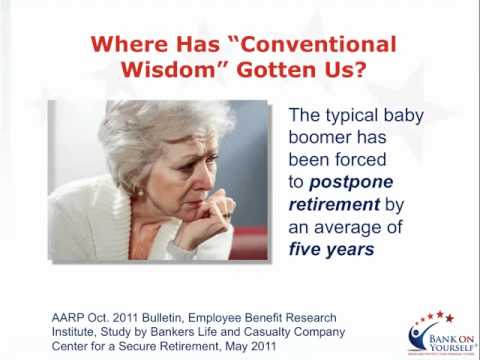
Have you been disappointed by your 401(k), IRA or other retirement plan?  Conventional wisdom tells us these plans are the best way to save and invest for retirement. Yet following this advice has resulted in financial insecurity for most Americans.

Because of this, most baby boomers have been forced to postpone retirement an average of five years.1

I’m often asked how using the Bank On Yourself method to save for retirement compares to traditional plans, so I put together this short video that reveals seven reasons Bank On Yourself makes an excellent retirement plan alternative.

Click the play button in the video below and see how many of these seven advantages you’d like to have in your financial plan…

HOW TO ADD GUARANTEES AND PREDICTABILITY TO YOUR FINANCIAL PLAN…

Would you like to find out how big your nest-egg could grow – guaranteed – if you added Bank On Yourself to your financial plan? No two plans are alike – yours would be custom-tailored to your unique situation, goals and dreams. To find out what your bottom-line numbers would be, request a FREE, no-obligation Analysis today.

If you’re wondering where you’ll find the money to fund your plan, keep in mind the Bank On Yourself Authorized Advisors are masters at helping people restructure their finances to free up money to fund a plan. Here are the eight most common places they look.

1.  Bankers Life and Casualty Center for a Secure Retirement, May 2011

Why conventional financial planning doesn’t work… and what you can do about it

This short video reveals the problems with the conventional wisdom about financial and retirement planning, and explains why the average family with a head of household age 60-70 has been able to save only 25% of what it will need for retirement.

Many readers of this blog have asked to see more specific examples showing how much guaranteed and predictable income you could have in retirement, using the Bank On Yourself method. So I’ve included a fascinating example on this video.

If you have the feeling your financial plan has been treading water (or going backwards) for far too long, you’ll want to be sure to watch this video now. It’s got some pretty cool animation in it, too!


TIRED OF WATCHING YOUR FINANCIAL PLAN GO NOWHERE?

Find out how the Bank On Yourself method can give you the financial security and predictability you want and deserve. It’s NEVER had a losing year in 160 years! Take the first step right now by requesting a FREE Bank On Yourself Analysis.

Wondering where you’ll find the funds to start a plan? Don’t worry! You’ll receive a referral to one of only 200 advisors in the country who have met the rigorous requirements to be a Bank On Yourself Authorized Advisor and can show you eight ways to find money to fund a plan that can help you reach as many of your goals as possible, in the shortest time possible.


Test Your Money and Investing IQ

You can win one of six valuable prizes by participating in our “Test Your Money and Investing IQ” blog contest – just enter your answer in the comments box below by midnight Monday, November 14.Financial-checklist

At a dinner party recently, I sat next to a retired business owner and we got into a conversation about money and finances.

In response to one of his questions, I mentioned an important principle of finance, at which point he turned to me and said, “I’m a CPA and an MBA and I’ve never heard of that!”

Actually, it’s fairly common that I meet highly educated people who are unaware of some of the really critical basics of how money and finances work.

Funny thing is that I think many of our subscribers know these principles, even if they don’t have alphabet soup after their names.

Applying a little logic and common sense (which is admittedly in short supply in our society today) is usually all that’s needed.

And to prove my point, I’m holding a contest to see how many of our subscribers can answer the questions below correctly.

If you answer even one of these questions correctly and/or insightfully, you can win a prize.

I know that people deepen their understanding more when they participate and articulate their thoughts, so I decided to “ethically bribe” you to take a shot at it by holding a contest.

Here’s all you have to do to enter the contest…

Prizes

Just type in your answer to any one or more of the five questions below, no later than Monday, November 14, at midnight.  If you want, you can comment on someone else’s answer to qualify to win.

After the contest ends, our team will pick the best entry (best because it’s correct, insightful, entertaining or a combination of those).  That person will win a $100 Amazon Gift Certificate.  And two runners-up will be chosen to receive their choice of a $25 Dining Gift Certificate, or a personally autographed copy of my best-selling book, Bank On Yourself: The Life-Changing Secret to Growing and Protecting Your Financial Future.

Three more winners will be chosen at random – all entries containing at least one correct answer will be entered into a random drawing for another $100 Amazon Gift Certificate and two prizes of your choice of a $25 Dining Gift Certificate or autographed book.  (Sorry – U.S. residents only.)

Although there are five questions, you don’t have to answer all of them to qualify.

So test your money IQ now by answering as many of these five questions as you want:

number1If you finance a $30,000 car through a finance company, your actual cost for the car is the money you spend on it, plus the interest you pay, less the value of your trade-in at the end of your loan repayment period.

Question:  If you pay cash for a car, what’s your actual cost for the car?

If you have a $20 stock and it goes up by 40%, how much money did you make on that stock?  (Hint:  This is about a key financial principle, not a math question.)

number3 According to Morningstar, Inc., the top-performing mutual fund for the last decade (ending December 31, 2009) enjoyed an 18% annual return.

However, the typical investor in that fund wasn’t so fortunate.

Question:  What was the annual return of the typical investor in that top-performing fund?  And why was their return so different from the return reported by the fund?

TIRED OF WATCHING YOUR FINANCIAL PLAN GO NOWHERE?

Find out how the Bank On Yourself method can give you the financial security and predictability you want and deserve.  It’s NEVER had a losing year in 160 years!  Take the first step right now by requesting a FREE Bank On Yourself Analysis.

Wondering where you’ll find the funds to start a plan?  Don’t worry!  You’ll receive a referral to one of only 200 advisors in the country who have met the rigorous requirements to be a Bank On Yourself Authorized Advisor and can show you where to find money you didn’t know you had to fund your plan.

number4 What percentage of mutual funds, financial advisors and investment advisory services underperform the overall market?  And why?

number5 You could have $10,000 in a mutual fund that reports an average annual return of 25% for four years… and at the end of the fourth year end up with only the $10,000 you started with.

How is that possible?

So there you have it – just answer one or more of these questions, or comment on someone else’s answer, no later than midnight, Monday, November 14, to get in the running to win one of the six prizes!

Comments

We’ll announce all the winners in a blog post later this month.

So scroll down to the comments box below and start typing!  (Note – all comments are moderated, so there will be some delay before your comment appears.)


Compare your Fear Factors choices to the rest of America

Financial Pumpkin With more than 500 responses in so far to The Bank On Yourself Fear Factors Challenge, you may be interested in knowing how your choices compare to the rest of America.
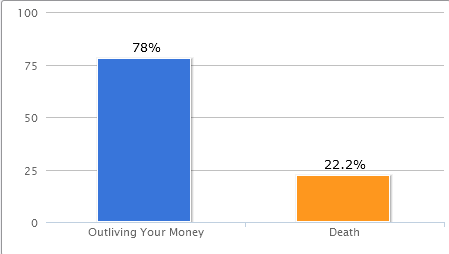
Here is how the responses to each of our 10 survey questions have broken down.  The percentages reveal which option our survey-takers find more scary!

You’ll see that snakes, blood, public nudity, eating fire-hot peppers, and even close proximity to a psychotic killer caused far fewer trembles than did the terrifying prospect of winding up in a serious financial jam.

Here’s what Americans find most scary…

1. Which of the following is more frightful to you?

  • 22.2% – Death
  • 78% – Outliving Your Money

    Question 1

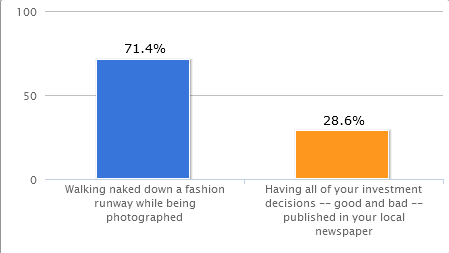
2. Which of the following is more frightful to you?

  • 28.6% – Having all of your investment decisions — good and bad — published in your local newspaper
  • 71.4% – Walking naked down a fashion runway while being photographed

Question 2

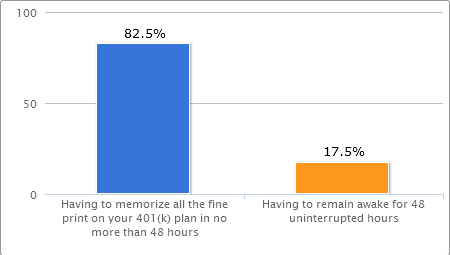
3. Which of the following is more frightful to you?

  • 17.5% – Having to remain awake for 48 uninterrupted hours
  • 82.5% – Having to memorize all the fine print on your 401(k) plan in no more than 48 hours

Question 3

4. Which of the following is more frightful to you?

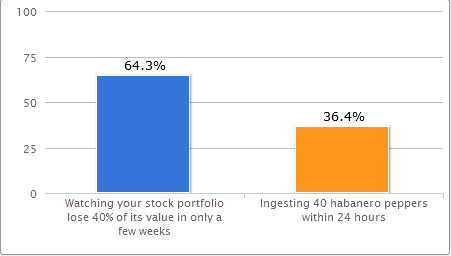
  • 64.3% – Watching your stock portfolio lose 40% of its value in only a few weeks
  • 36.4% – Ingesting 40 habanero peppers within 24 hours

Question 4

The ultimate financial security blanket

Did you know that the Bank On Yourself wealth-building method has NEVER had a losing year? Used by Walt Disney and J.C. Penney, it has stood the test of time for more than 160 years.

To find out how you can grow your nest-egg safely and predictably, even when stocks real estate and other investments tumble… and how much money you could have – GUARANTEED – on the day you plan to retire, request your FREE no-obligation Analysis and Recommendations now.

5. Which of the following is more frightful to you?

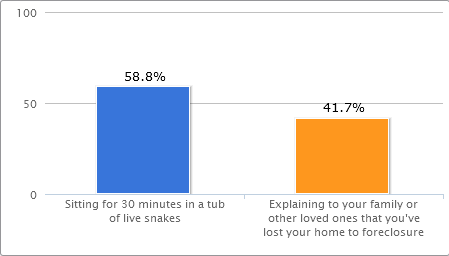
  • 58.8% – Sitting for 30 minutes in a tub of live snakes
  • 41.7% – Explaining to your family or other loved ones that you’ve lost your home to foreclosure

Question 5

6. Which of the following is more frightful to you?

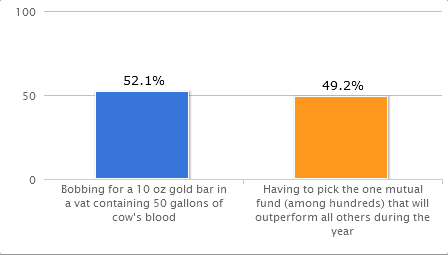
  • 49.2% – Having to pick the one mutual fund (among hundreds) that will outperform all others during the year
  • 52.1% – Bobbing for a 10 oz gold bar in a vat containing 50 gallons of cow’s blood

Question 6

7. Which of the following is more frightful to you?

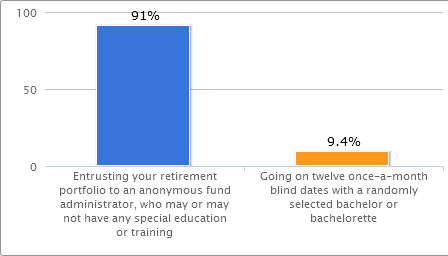
  • 9.4% – Going on twelve once-a-month blind dates with a randomly selected bachelor or bachelorette
  • 91% – Entrusting your retirement portfolio to an anonymous fund administrator, who may or may not have any special education or training

Question 7

Editors Note: Although 9 out of 10 Americans fear entrusting their retirement to an incompetent administrator, millions of Americans may unknowingly be doing exactly that right now! Read our shocking exposé and learn the facts!

8. Which of the following is more frightful to you?

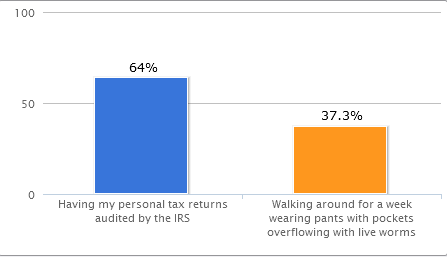
  • 64% – Having my personal tax returns audited by the IRS
  • 37.3% -Walking around for a week wearing pants with pockets overflowing with live worms

Question 8

9. Which of the following is more frightful to you?

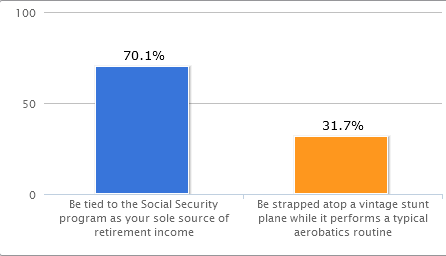
  • 31.7% – Be strapped atop a vintage stunt plane while it performs a typical aerobatics routine
  • 70.% – Be tied to the Social Security program as your sole source of retirement income

Question 9

10. Which of the following is more frightful to you?

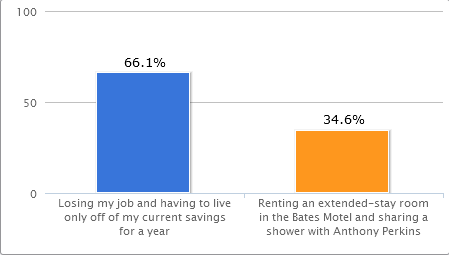
  • 66.1% – Losing my job and having to live only off of my current savings for a year
  • 34.6% -Renting an extended-stay room in the Bates Motel and sharing a shower with Anthony Perkins

Question 10

Were you surprised by any of your responses?

These results are a sad commentary on the financial condition and current state of mind of so many of our family members, friends, neighbors and colleagues.

The definition of insanity is doing the same things in the same way and hoping for different results.  So, if you’re ready to find a better way to save and invest for your financial future that gives you peace of mind and lifetime financial security, check out the Bank On Yourself method.

To find out how much brighter your financial picture could be if you added Bank On Yourself to your financial plan, request your free, no-obligation Analysis now, while it’s fresh on your mind!


Bank On Yourself Money Alert!

Teleconference replay reveals the steps you must take immediately to protect yourself from Wall Street’s bloodbath

I just held an urgent Teleconference on what you should do right now to protect your family’s financial security.

A number of people told us they weren’t able to attend and asked if it was recorded so they – and the people they care about – could still listen to it.

You can listen to a replay of it below, or you can download the recording as an MP3 and listen to it on your own player or iPod now at:

Audio clip: Adobe Flash Player (version 9 or above) is required to play this audio clip. Download the latest version here. You also need to have JavaScript enabled in your browser.

I urge you to shut the door and put out a “do not disturb” sign while you listen to this critically important information which includes answers to timely questions such as:

  • Should you stay in the market despite the turbulence and wait for the market to rebound?
  • Is now the time to shift into gold?
  • Where else can you find shelter from the storm?
  • What can we do to encourage Washington to get its act together?

Find out what you need to do right now to protect your hard-earned savings and take back control of your financial future here:

Audio clip: Adobe Flash Player (version 9 or above) is required to play this audio clip. Download the latest version here. You also need to have JavaScript enabled in your browser.

Are you ready to do something different?

And if you’re ready to find out how the Bank On Yourself method can give you the financial security and predictability you want and deserve, take the first step right now by requesting a free Bank On Yourself Analysis.

You’ll also get a referral to one of only 200 advisors in the country who have met the rigorous requirements to be a Bank On Yourself Authorized Advisor, who can answer your questions and show you how much your financial picture could improve when you add Bank On Yourself to your financial plan.

Nobody is going to twist your arm, and you won’t even be asked to buy anything at your first meeting with your Authorized Advisor.

But at least you’ll know whether Bank On Yourself makes sense for you and your family.  So please request your free Analysis today.


Bank On Yourself Round-Up for week of July 13, 2011

Here are short summaries of three of the most interesting and thought-provoking items that have crossed my desk this week.  Enjoy… and tell us what you think!roundup

Would you be prepared if you suffered a 30% pay cut?

A shocking new report reveals that the average person’s pay levels off when they’re in their 40′s.  After that, about all you’ll be likely to count on will be cost-of-living adjustments to keep pace with inflation.

That will come as a real surprise to many people who assume their pay will continue to rise as they get older.

And if you lose your job while in your 50′s, you’re likely to remain jobless longer than when you were younger, according to the report.

Salary CutRead this sobering and well documented article from the Wall Street Journal.1

What’s your best self-defense?  When planning for retirement, assume the only salary increases you’ll get will be cost-of-living adjustments.  And identify a worse-case scenario – such as a 20% pay cut during your final ten years in the workforce – and try living on that income and putting the rest into savings.

Read the rest of this page »


How Everyone Can Love Paying Bills and Taxes: No, We’re Not Crazy!

A core tenet of the Bank on Yourself Nation is that money should always bring pleasure or satisfaction, never regret or guilt.overwhelmed by bills

For so many people, that principle seems unrealistic, especially considering how very hard it is most months just to stay afloat – paying for necessities such as groceries, medicines, utilities, transportation, insurance and the like.  Oh yes, let’s not forget the always hungry tax monster!

Seems to so many of us that our paychecks are swallowed whole by our obligations before we ever get the chance to even sample the flavor of having some accumulated cash in our pockets and bank accounts.

To which we can only respond… how wonderful!

Wonderful? Really? Paying Bills! And Taxes?”

Absolutely.

Read the rest of this page »


Top 16 Investing and Savings Myths

All the statements listed below are common financial myths.  Accepting any of them as fact could lead to costly financial missteps…

See how many of these common beliefs you already recognize as flawed and which ones you have yet to unmask.

Unmasked Myths

As you may discover, what we’ve been taught by mainstream money experts and well-intentioned friends and family isn’t always accurate.

The Myths:

  1. Over time, the stock market has consistently proven the best and most reliable investment vehicle for the vast majority of Americans
  2. Investors need to accept risk and volatility in order to generate meaningful profits
  3. Home ownership and appreciation is a reliable vehicle for protecting and growing your wealth
  4. 401(k)s make effective investment vehicles, if only because your employer matches your own contributions
  5. Your 401(k) plan administrator must be a licensed, professionally trained and carefully screened financial expert
  6. The fees you pay for your IRA, 401(k) and other retirement funds have only a trivial impact on your ultimate returns
  7. You will not require as much income when you retire as you need now, especially since you’ll qualify for a lower tax bracket
  8. It is never possible to know with any certainty the value of your retirement account at intervals down the road, because market fluctuations are unpredictable
  9. Wise retirement planners recommend you aim to make your retirement income last to age of the average American life expectancy, currently 77.9 years
  10. Always defer taxes as far into the future as possible, especially when you wish to accumulate a larger retirement nest egg
  11. People of modest income can’t possibly set aside $1 million or more for their retirement
  12. Before you can begin saving for the future, first you have to dig your way out of debt
  13. Paying cash is the ideal method of purchasing big-ticket items, such as cars and vacations
  14. Effective savings and investing strategies are too complex for amateurs.  Only professionally trained money managers consistently succeed
  15. If you follow the advice of mainstream financial experts and don’t stray, your nest egg will be safe and grow large over time
  16. To receive quality, personalized attention from highly trained financial advisors, you have to already be wealthy, or close to it

©2011 Hayward-Yellen 100 Ltd Partnership


Physician heals his financial ills with Bank On Yourself

After losing half of his retirement savings not once, but TWICE, during the past decade, Dr. Bryan Kuns decided, “there has to be a better way.”

Dr. Bryan Kuns

Dr. Bryan Kuns

A family and occupational medicine practitioner for 25 years, the doctor realized that, at age 50, he and his wife might only have one more chance to get it right.  “I need some more guarantees than taking a chance and gambling again with my retirement,” Bryan realized.

A little over one year ago, he heard about Bank On Yourself.  Intrigued, he began reading everything he could get his hands on about the concept.  Then he requested a referral to a Bank On Yourself Authorized Advisor and a Free Analysis.

It’s an answered prayer.  I’m sleeping a lot better at night, now.  The guarantees that this program has are what I was looking for.” –Dr. Bryan Kuns

Bryan offered to share his story with you.  Whether you already use Bank On Yourself, or you’ve been considering adding it to your financial plan, you’ll learn something of value from this interview.  You can listen to the interview by pressing the play button below, or you can download the entire interview as an Mp3 and listen on your own player or iPod…

Audio clip: Adobe Flash Player (version 9 or above) is required to play this audio clip. Download the latest version here. You also need to have JavaScript enabled in your browser.

You can also download a transcript of the interview here.

In this interview, you’ll discover…


Retiring Boomers’ Savings Fall Far Short

“The 401k generation is beginning to retire, and it isn’t a pretty sight.”

That’s the conclusion of a recent Wall Street Journal study.1 But the most shocking revelation is just how big the gap is between how much retirement income people will need to maintain their standard of living… and how much they’ve actually saved:

Many have less than one-quarter of what they’ll need

And how are they dealing with this challenge?

Facing shortfalls, many are postponing retirement, moving to cheaper housing, buying less-expensive food, cutting back on travel, taking bigger risks with their investments and making other sacrifices they never imagined.” 1

Sad Baby BoomerLike Carol Dailey, who is continuing to work at age 71 because her 401(k) took a hit in the 2008 market crash.  She also cut back spending for entertainment and food, and is substituting boxed wine for the ones she used to enjoy from her favorite vineyards.

Her financial advisor is planning to help her be able to retire by shifting her assets into riskier investments that can “return 10% a year.”

Hmmm… I wonder if that’s the same financial advisor who advised her on where to invest her money prior to the 2008 market plunge?

If people could take more risk, and do it successfully, why haven’t they been doing that all along?

Isn’t that the classic definition of insanity?

How much more evidence do we need to know that 401(k)’s and “doing all the right things we were told to do financially” aren’t working?

Read the rest of this page »


Next Page »